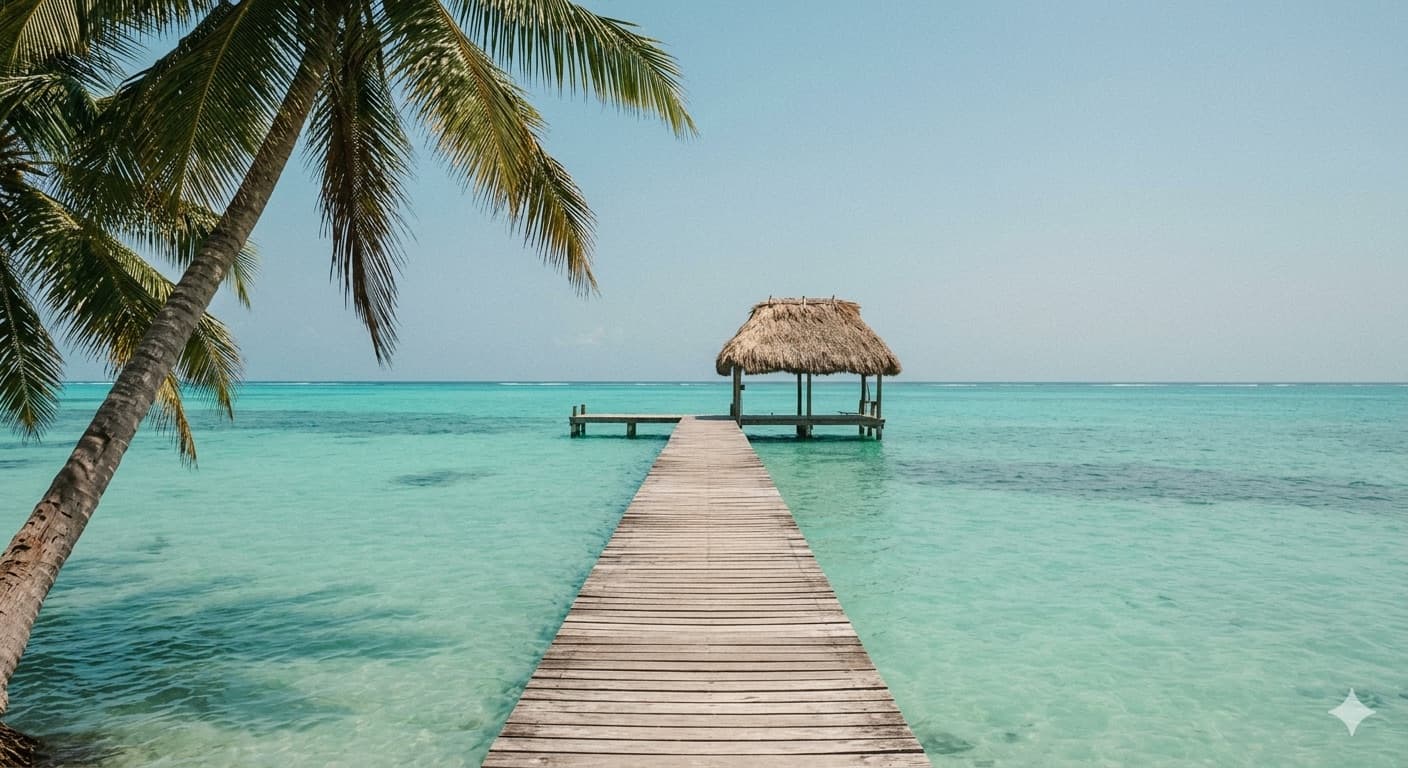
An American or Canadian buyer scouting a condo on Ambergris Caye, a townhouse in Placencia, a remote-work setup in Hopkins, or a hillside lot near San Ignacio runs into a financing market that prices everything in dollars but is not really built for foreigners. Local banks do lend to non-residents, when they feel like it, usually at 10 to 13 percent with 30 to 50 percent down and a 50 to 70 percent loan-to-value cap.[1] The closing process is at least in English. The transfer tax, on the other hand, is not priced kindly.
Eight percent. That's the stamp duty on a non-resident purchase above the first roughly US$10,000 of value. Belize residents pay 5%.[2] On a $400,000 property, the difference is $12,000 of pure transfer cost that doesn't appear anywhere on the listing site. Plan for it before anything else.
This page covers what financing looks like in Belize, what the three other paths cost, and where a cross-border mortgage fits in the picture.
How cross-border mortgages work in Belize
A handful of US-based cross-border lenders write USD-denominated loans for North American buyers in Belize. The structure is borrowed from Canadian mortgages — 25-year amortization, 5-year rate resets, qualifying off North American income rather than any Belize footprint. The USD denomination matches how the country prices property. The Belize dollar is pegged 2:1 to USD, with the peg in place since May 1976, and most listings quote dollars directly, so there is no meaningful FX risk on the financed property.[3] There is no fideicomiso requirement here either. Foreigners can hold direct fee-simple title, the same kind of title a US or Canadian buyer would see at home.[4]
Down payments start at 25%. Rates among the cross-border lenders writing in this market sit in roughly the 7% to 8% range for Belize; pricing varies country-by-country and lender-by-lender.
For broader context on how a cross-border mortgage compares to a HELOC, seller financing, or cash, see how to finance property abroad. For why the 25-year amortization with 5-year resets travels well across borders, see Canadian mortgage structure abroad.
What you'd pay otherwise
A $400,000 two-bedroom condo on Ambergris Caye, walked through the four common paths North American buyers take.
| Path | Rate | Cash on day one | Monthly P&I | Notes |
|---|---|---|---|---|
| Cross-border mortgage | 7% to 8% | ~$145K ($100K down + $45K closing) | ~$2,220 on $300K, 25-yr | USD loan, qualifies off NA income |
| Local Belize bank | 10% to 13% | ~$245K ($200K down + $45K closing) | ~$1,930 on $200K, 20-yr | Smaller loan, more cash on day one, slow underwriting |
| US HELOC | Prime + 1% to 2%, currently 9% to 10% | ~$45K closing (HELOC funds the buy) | ~$3,200 interest-only on $400K | Variable rate, encumbers your US property |
| Cash | n/a | ~$445K | $0 | No financing cost, but opportunity cost on the capital |
The local-bank row is where most buyers get stuck. Atlantic Bank, Belize Bank, Heritage Bank, and Scotiabank Belize will lend to non-residents, but the LTV cap of 50% to 70% means at least $200K of cash on the table before closing costs.[5] Underwriting typically runs 60 to 120 days. The rate sits at 10% to 13%, USD or BZD, on a smaller loan than you wanted.
The HELOC path is the route most American buyers default to, partly because they already have a paid-down US house and partly because the application is one phone call instead of three months of appraisal. The catch is the variable rate. HELOCs reset off prime, which has moved a lot over the past few years. The structural problem is using your US house as collateral against a Belize purchase. If your US home value drops or the bank cuts your line, you have a problem in two countries instead of one.
Cash looks free. It isn't. A $445,000 outlay at a 6% blended return over five years foregoes roughly $155,000 of compounded growth. Cash is the right answer when the alternative isn't available, when the buyer has personal reasons to avoid debt, or when the property is small enough that the math doesn't move much. On a $400,000 Ambergris Caye condo, the math moves.
Country-specific friction
The 8% non-resident stamp duty is the single most important number on this page. It applies on the value above the first US$10,000 of consideration (roughly BZ$20,000 at the 2:1 peg), so basically any habitable property pays the full rate after that small allowance. Residents pay 5%, which is why some long-term buyers eventually structure as residents through the QRP program. For a non-resident at $400,000, the stamp duty alone is roughly $31,200.
Add legal fees of 1% to 2% and title search and registration of $500 to $1,500, and total closing costs land at roughly 10% to 12% of the purchase price.[6] That is meaningfully higher than Mexico, Costa Rica, or Panama. Belize's English-language process makes the closing easier to read, while the line items are larger. We publish updated Belize cross-border rates each week in the Brief.
Belize uses common-law title and English-language documentation. That removes a category of risk that buyers in Mexico and Spain pay legal teams to manage. Strata title is the standard for condo developments, governed by the Strata Titles Act, so a condo buyer should expect the same kind of HOA and shared-systems documentation a US or Canadian condo purchase generates.[7] The BZD's 2:1 USD peg has held since 1976, which is one reason Belize attracts buyers who got burned on peso or euro exposure elsewhere.
A property purchase by itself does not grant residency. The Qualified Retired Persons (QRP) program is the most common path for buyers age 45 and over with at least US$2,000 a month in passive income from a foreign source. QRP holders pay no Belize tax on foreign-source income.[8] The rules shift periodically and the program's requirements have been adjusted over the years, so verify current eligibility before assuming the program will fit your situation.
Worked example
A 62-year-old US retiree with $80,000 a year in passive income (Social Security plus a brokerage account) buys a $400,000 two-bedroom condo on Ambergris Caye.
Down payment: $100,000, which is 25% on a cross-border mortgage. Closing costs: about $45,000, with the 8% non-resident stamp duty doing roughly $31,200 of that damage. Cross-border financing: $300,000 at a placeholder 7.5% (the rate used for internal modeling), 25-year amortization. Monthly principal and interest run about $2,220.
Run that against local financing. The same buyer would qualify for at most 50% LTV at a Belize bank, so a $200,000 loan at 11% over 20 years. Monthly P&I lands around $2,065. The catch: $200,000 of cash down instead of $100,000, plus the same $45,000 in closing. That's $145,000 more cash on day one for a payment difference of about $155 per month. The crossover point, where the local-bank cash savings overtake the cross-border path payment difference, sits well past year 30.
Run it against cash. $445,000 out of pocket, no financing cost, no monthly payment. But the same $445,000 invested at a 6% blended return compounds to about $155,000 over five years. That's the opportunity cost the cash buyer is paying without seeing it on a statement.
Five-year all-in. The cross-border buyer puts $145,000 in on day one, pays $133,000 in P&I, ends with a $268,000 mortgage balance, and gives up roughly $35,000 of opportunity cost on the down payment. The local-bank buyer puts $245,000 in on day one, pays $124,000 in P&I, ends with a $164,000 balance, and gives up roughly $60,000 on the larger down payment. The cash buyer is out $445,000 plus $155,000 of opportunity cost.
The cross-border path wins on the math in Belize for two reasons that are particular to this market. Local financing demands too much cash and prices at too high a rate. And cash, when 6% blended returns are reasonable to assume, is not free.
Eligibility and application
If you have North American income (W-2, 1099, or documented self-employment) and a credit profile that would clear a US prime mortgage, the cross-border application path works off your North American documentation. The Belize property goes through standard appraisal and title work locally. Closing happens in USD against direct title, with funds wired from your US or Canadian account.
Start with the financing pillar to confirm your situation fits. From there the application looks like a domestic mortgage with a longer title timeline, where Belize closings move at Belize speed and 60 to 90 days is typical.
FAQ
Can foreigners get a mortgage in Belize?
Yes, though local-bank options are limited. Belize banks will lend to non-residents at 50% to 70% LTV, rates of 10% to 13%, and 15- to 20-year terms. Documentation is in English, which simplifies the process compared to Mexico or Spain, while underwriting is conservative and timelines are long. Most foreign buyers either pay cash, draw on a US or Canadian HELOC, or use a cross-border product structured around North American income.
What is the down payment for a non-resident buying in Belize?
Local banks require 30% to 50% down for non-residents. Cross-border financing requires 25% down and qualifies off your North American income rather than your Belize residency status.
How much are closing costs in Belize?
Plan for roughly 10% to 12% of the purchase price for non-residents. The largest line item is the 8% stamp duty on non-resident purchases above the first roughly US$10,000 of value. Belize residents pay 5%. Legal fees run 1% to 2%, and title search and registration cost about $500 to $1,500.
Do I need to be a Belize resident to buy property?
No. Foreigners can hold direct fee-simple title, with no fideicomiso or trust structure required. A property purchase does not grant residency on its own. Buyers age 45 and over with US$2,000 a month in foreign-source passive income may qualify for the Qualified Retired Persons program, which provides residency and exempts foreign-source income from Belize tax.
Are property prices in Belize quoted in BZD or USD?
Most listings, especially in Ambergris Caye, Caye Caulker, and Placencia, are quoted in USD. The Belize dollar is pegged 2:1 to USD and the peg has held since May 1976, so there is no meaningful FX risk on a Belize property purchase. This is a structural advantage over Mexico, Costa Rica, and most European destinations.
What's the catch with using a US HELOC?
A HELOC funds the purchase quickly and at a familiar rate, while it carries variable-rate risk and uses your US home as collateral against a Belize purchase. If your US home value drops, your HELOC limit can be cut. If the Belize property has issues, you've encumbered both sides. A cross-border mortgage isolates the Belize property as the collateral and locks the rate for five years at a time.
- Re/Max Belize Real Estate, "Belize Real Estate Financing." remaxbelizerealestate.com
- Re/Max Belize, "Stamp Tax (Stamp Duty) on Property in Belize." remaxbelizerealestate.com
- Wikipedia summary of Central Bank of Belize peg, in place since May 1976. en.wikipedia.org
- Re/Max Belize, "Types of Property Ownership in Belize." remaxbelizerealestate.com
- Expat Focus, "Belize Property Financing." expatfocus.com
- Will Mitchell Real Estate, "Belize Property Taxes." willmitchellrealestate.com
- Marisol Belize Attorneys, "Strata Real Estate" (Strata Titles Act, Chapter 196). attorneybelize.com
- Belize Tourism Board, "Retirement Program (QRP)." belizetourismboard.org